Today's
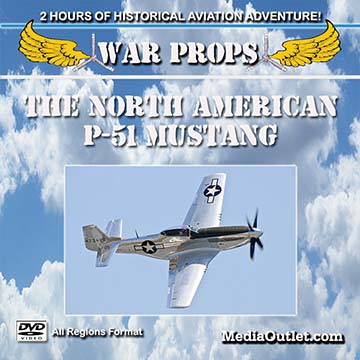
EarthStation1.com 15% Off Commemorative Memorial Title: War Props:
The P-51 Mustang Documentaries DVD, Download, USB Drive
Today, October 26, 2025
October 26, 1940: Aviation: The History
Of Aviation: The History Of Military Aviation: Maiden Flights:
Military Aviation Maiden Flights: -- The P-51 Mustang makes its
first flight. The North American Aviation P-51 Mustang is an
American long-range, single-seat fighter and fighter-bomber used
during World War II and the Korean War, among other conflicts. The
Mustang was designed in 1940 by North American Aviation (NAA) in
response to a requirement of the British Purchasing Commission.
The Purchasing Commission approached North American Aviation to
build Curtiss P-40 fighters under license for the Royal Air Force
(RAF). Rather than build an old design from another company, North
American Aviation proposed the design and production of a more
modern fighter. The prototype NA-73X airframe was rolled out on
September 9, 1940, 102 days after the contract was signed, and
first flew on October 26. The Mustang was originally designed to
use the Allison V-1710 engine, which, in its earlier variants, had
limited high-altitude performance. The addition of the Rolls-Royce
Merlin to the P-51B/C model transformed the Mustang's performance
at altitudes above 15,000 ft, allowing the aircraft to compete
with the Luftwaffe's fighters. From late 1943, P-51s were used by
the USAAF's Eighth Air Force to escort bombers in raids over
Germany, while the RAF's Second Tactical Air Force and the USAAF's
Ninth Air Force used them as fighter-bombers, roles in which the
Mustang helped ensure Allied air superiority in 1944. The P-51 was
also used by Allied air forces in the North African,
Mediterranean, Italian and Pacific theaters. During World War II,
Mustang pilots claimed to have destroyed 4,950 enemy aircraft. At
the start of the Korean War, the Mustang was the main fighter of
the United Nations until jet fighters, including the F-86, took
over this role; the Mustang then became a specialized
fighter-bomber. Despite the advent of jet fighters, the Mustang
remained in service with some air forces until the early 1980s.
After the Korean War, Mustangs became popular civilian warbird and
air racing aircraft. On Sale @ 15% Off Discount Till Midnight PT!
https://store.earthstation1.com/war-props-the-p51-mustang-d51.html
Today's
EarthStation1.com 15% Off Commemorative Memorial Title: Attack In
The Pacific (1945) + Eric Sevareid Bonus MP4 Download DVD
Today, October 26, 2025

October 26, 1942: World War II: The
Pacific War (The Asia-Pacific War, The Asiatic-Pacific Theater,
The Pacific Theater Of World War II): The Pacific Ocean Theater Of
World War II: The South West Pacific Area (SWPA): Operation
Cartwheel: The Solomon Islands Campaign: The Battle Of Guadalcanal
(The Guadalcanal Campaign, Operation Watchtower): The Battle Of
The Santa Cruz Islands (The Battle Of Santa Cruz, The Third Battle
Of The Solomon Sea, (The Battle Of The South Pacific): -- The U.S.
Navy aircraft carrier USS Hornet is sunk, and another aircraft
carrier, the USS Enterprise, is heavily damaged, while two
Japanese carriers and one cruiser are heavily damaged. The Battle
Of The Santa Cruz Islands (October 25-27, 1942) was the fourth
carrier battle of the Pacific campaign of World War II and the
fourth major naval engagement fought between the United States
Navy and the Imperial Japanese Navy during the lengthy and
strategically important Guadalcanal campaign. As in the battles of
Coral Sea, Midway, and the Eastern Solomons, the ships of the two
adversaries were rarely in direct visual range of each other.
Instead, almost all attacks by both sides were mounted by carrier
or land-based aircraft. In an attempt to drive Allied forces from
Guadalcanal and nearby islands and end the stalemate that had
existed since September 1942, the Imperial Japanese Army planned a
major ground offensive on Guadalcanal for 20-25 October 1942. In
support of this offensive, and with the hope of engaging Allied
naval forces, Japanese carriers and other large warships moved
into a position near the southern Solomon Islands. From this
location, the Japanese naval forces hoped to engage and decisively
defeat any Allied (primarily U.S.) naval forces, especially
carrier forces, that responded to the ground offensive. Allied
naval forces also hoped to meet the Japanese naval forces in
battle, with the same objectives of breaking the stalemate and
decisively defeating their adversary. The Japanese ground
offensive on Guadalcanal was under way in the Battle For Henderson
Field while the naval warships and aircraft from the two
adversaries confronted each other on the morning of 26 October
1942, just north of the Santa Cruz Islands. After an exchange of
carrier air attacks, Allied surface ships were forced to retreat
from the battle area with one carrier sunk and another heavily
damaged. The participating Japanese carrier forces also retired
because of high aircraft and aircrew losses plus significant
damage to two carriers. Although a tactical victory for the
Japanese in terms of ships sunk and damaged, the loss of many
irreplaceable, veteran aircrews would prove to be a long term
strategic advantage for the Allies, whose aircrew losses in the
battle were relatively low and could be quickly replaced. The
Guadalcanal Campaign, also known as the Battle Of Guadalcanal and
codenamed Operation Watchtower was a military campaign fought
between 7 August 1942 and 9 February 1943 on and around the island
of Guadalcanal in the Pacific theater of World War II. It was the
first major offensive by Allied forces against the Empire Of
Japan. On 7 August 1942, Allied forces, predominantly United
States Marines, landed on the islands of Guadalcanal, Tulagi, and
Florida in the southern Solomon Islands, with the objective of
denying their use by the Japanese to threaten Allied supply and
communication routes between the US, Australia, and New Zealand.
The Allies also intended to use Guadalcanal and Tulagi as bases to
support a campaign to eventually capture or neutralize the major
Japanese base at Rabaul on New Britain. The Allies overwhelmed the
outnumbered Japanese defenders, who had occupied the islands since
May 1942, and captured Tulagi and Florida, as well as an airfield
(later named Henderson Field) that was under construction on
Guadalcanal. Powerful American and Australian naval forces
supported the landings. Surprised by the Allied offensive, the
Japanese made several attempts between August and November to
retake Henderson Field. Three major land battles, seven large
naval battles (five nighttime surface actions and two carrier
battles), and continual (almost daily) aerial battles, culminated
in the decisive Naval Battle Of Guadalcanal in early November, in
which the last Japanese attempt to bombard Henderson Field from
the sea and land with enough troops to retake it was defeated. In
December, the Japanese abandoned their efforts to retake
Guadalcanal and evacuated their remaining forces by 7 February
1943, in the face of an offensive by the US Army's XIV Corps. The
Guadalcanal campaign was a significant strategic combined arms
Allied victory in the Pacific theater. Along with the Battle of
Midway, it has been called a turning point in the war against
Japan. The Japanese had reached the peak of their conquests in the
Pacific. The victories at Milne Bay, Buna-Gona, and Guadalcanal
marked the Allied transition from defensive operations to the
strategic initiative in the theater, leading to offensive
operations such as the Solomon Islands, New Guinea, and Central
Pacific campaigns, that eventually resulted in Japan's surrender
and the end of World War II. On Sale @ 15% Off Discount Till
Midnight PT!
https://store.earthstation1.com/attack-in-the-pacific-dvd-1945-motion-pic1945.html
Today's
EarthStation1.com 15% Off Commemorative Memorial Title: Carriers:
Aircraft Carrier History TV Series DVD, Download, USB Drive
Today, October 26, 2025
October 25-26, 1944: World War II: The
Pacific War (The Asia-Pacific War, The Asiatic-Pacific Theater,
The Pacific Theater Of World War II): The Pacific Ocean Theater Of
World War II: The Southwest Pacific Theater Of World War II: The
Philippines Campaign (1944-1945) (Battle Of The Philippines,
Second Philippines Campaign, The Liberation Of The Philippines,
Operation Musketeer I, II, and III): The Battle Of Leyte Gulf: The
Battle Off Cape Engano (October 25-26, 1944) -- During the final
attempt of the Imperial Japanese Navy to win the war, the Japanese
aircraft carrier Zuikaku ("Auspicious Crane" in
Japanese), the last surviving Japanese carrier to have attacked
Pearl Harbor, is sunk by American Grumman TBF Avenger torpedo
planes of the U.S. Third Fleet's Fast Carrier Task Force (TF 38.
Zuikaku was the only Japanese fleet carrier (as distinguished from
a light carrier) to have been sunk by aircraft-launched torpedoes,
as all others were sunk by dive bombers or submarine-launched
torpedoes. On Sale @ 15% Off Discount Till Midnight PT!
https://store.earthstation1.com/carriers-complete-14-part-tv-series-4-dvd-144.html
Today's
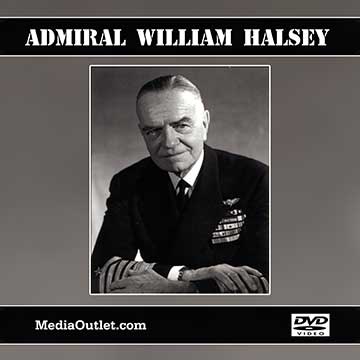
EarthStation1.com 15% Off Commemorative Memorial Title: Admiral
William Halsey Documentaries & Biographies DVD, Download, USB
Today, October 26, 2025
October 26, 1944: World War II: The
Pacific War (The Asia-Pacific War, The Asiatic-Pacific Theater,
The Pacific Theater Of World War II): The Pacific Ocean Theater Of
World War II: The Southwest Pacific Theater Of World War II: The
Philippines Campaign (1944-1945) (Battle Of The Philippines,
Second Philippines Campaign, The Liberation Of The Philippines,
Operation Musketeer I, II, and III): The Battle Of Leyte Gulf:
Crisis - U.S. Seventh Fleet's Calls For Help: -- Shortly after
08:00, desperate messages calling for assistance began to come in
from Seventh Fleet, which had been engaging Japanese Admiral
Nishimura's "Southern Force" in battle in Surigao Strait
since 02:00. One message from Kinkaid, sent in plain language,
read: "My situation is critical. Fast battleships and support
by air strikes may be able to keep enemy from destroying CVEs and
entering Leyte." Halsey recalled in his memoirs that he was
shocked at this message, recounting that the radio signals from
Seventh Fleet had come in at random and out of order because of a
backlog in the signals office. It seems that he did not receive
this vital message from Kinkaid until around 10:00. Halsey later
claimed he knew Kinkaid was in trouble, but he had not dreamed of
the seriousness of this crisis. One of the most alarming signals
from Kinkaid reported, after their action in Surigao Strait,
Seventh Fleet's own battleships were critically low on ammunition.
Even this failed to persuade Halsey to send any immediate
assistance to Seventh Fleet. In fact, Seventh Fleet's battleships
were not as short of ammunition as Kinkaid's signal implied, but
Halsey did not know that. On Sale @ 15% Off Discount Till Midnight
PT!
https://store.earthstation1.com/admiral-william-halsey-documentaries-dvd-world-war-ii.html
Today's
EarthStation1.com 15% Off Commemorative Memorial Title: Admiral
Chester Nimitz Documentaries DVD, Video Download, USB Drive
Today, October 26, 2025

October 26, 1944: World War II: The
Pacific War (The Asia-Pacific War, The Asiatic-Pacific Theater,
The Pacific Theater Of World War II): The Pacific Ocean Theater Of
World War II: The Southwest Pacific Theater Of World War II: The
Philippines Campaign (1944-1945) (Battle Of The Philippines,
Second Philippines Campaign, The Liberation Of The Philippines,
Operation Musketeer I, II, and III): The Battle Of Leyte Gulf:
Crisis - U.S. Seventh Fleet's Calls For Help: --- From 3,000 miles
away in Pearl Harbor, Admiral Nimitz had been monitoring the
desperate calls from Rear Admiral Clifton Sprague's Task Unit
77.4.3 ('Taffy 3'), who had been caught by surprise by Japanese
Admiral Takeo Kurita's mighty Center Force. Nimitz sent Halsey a
terse message: "TURKEY TROTS TO WATER GG FROM CINCPAC ACTION
COM THIRD FLEET INFO COMINCH CTF SEVENTY-SEVEN X WHERE IS RPT
WHERE IS TASK FORCE THIRTY FOUR RR THE WORLD WONDERS." The
first four words and the last three were not a sarcastic comment;
they were "padding" used to confuse enemy cryptanalysis
(the beginning and end of the true message were marked by double
consonants). Though the communications staff on Halsey's flagship
correctly deleted the first section of padding, they mistakenly
retained the last three words in the message finally handed to
Halsey. These last three words - probably selected by a
communications officer at Nimitz's headquarters - may have been
meant as a loose quote from Tennyson's poem on "The Charge of
the Light Brigade" ( trenchantly mourning the appalling
futility of the charge "Not tho' the soldier knew, someone
had blunder'd... Charging an army, while all the world wonder'd")
- a quote suggested by the coincidence that this day, October 25,
was the 90th anniversary of the Battle of Balaclava. While the
three words harking to this quote were not intended as a
commentary on the current crisis off Leyte, Halsey, when he read
the message, thought that the last words "THE WORLD WONDERS"
were a biting piece of criticism from Nimitz. In a wild response,
Halsey threw his cap to the deck and broke into "sobs of
rage". Rear Admiral Robert Carney, his Chief Of Staff,
confronted him by yelling at Halsey "Stop it! What the hell's
the matter with you? Pull yourself together!" Finally, at
11:15, more than three hours after Halsey stubbornly ignored the
first distress messages from Seventh Fleet had been received by
his flagship, Halsey at last ordered TF 34 (Task Force 34) to turn
around and head southwards towards Samar. At this point, Lee's
battleships were almost within gun range of Ozawa's force. Two and
a half hours were then spent refuelling TF 34's accompanying
destroyers. Despite this change in orders, after the long
succession of delays, it was too late for TF 34 to give any
practical help to Seventh Fleet, other than to assist in picking
up survivors from Taffy 3, and too late even to intercept Kurita's
force before it made its escape through San Bernardino Strait. On
Sale @ 15% Off Discount Till Midnight PT!
https://store.earthstation1.com/admiral-chester-nimitz-documentaries-dvd-world-war-ii.html
Today's
EarthStation1.com 15% Off Commemorative Memorial Title: The Battle
Of Leyte Gulf DVD, MP4 Video Download, USB Flash Drive
Today, October 26, 2025
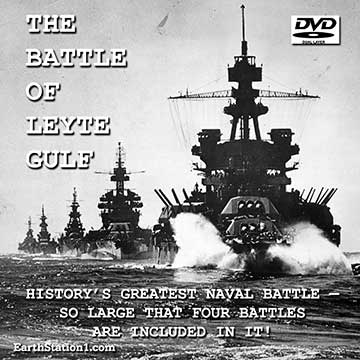
October 26, 1944: October 25-26, 1944:
World War II: The Pacific War (The Asia-Pacific War, The
Asiatic-Pacific Theater, The Pacific Theater Of World War II): The
Pacific Ocean Theater Of World War II: The Southwest Pacific
Theater Of World War II: The Philippines Campaign (1944-1945)
(Battle Of The Philippines, Second Philippines Campaign, The
Liberation Of The Philippines, Operation Musketeer I, II, and
III): The Battle Of Leyte Gulf: -- The largest naval battle in
history, The Battle Of Leyte Gulf, ends with an overwhelming
American naval and naval air victory over the Japanese navy and
naval air forces, and inexorably changes the course of World War
II in the Pacific against the Japanse Empire. The Battle Of Leyte
Gulf was fought in waters near the Philippine islands of Leyte,
Samar and Luzon, from October 23-26, 1944, between combined
American and Australian forces and the Imperial Japanese Navy. The
battle involved 216 U.S. warships and 64 Japanese ships and
resulted in the destruction of the Japanese Navy including the
Japanese Battleship Musashi, one of the largest ever built. On
October 20 , United States troops invaded the island of Leyte as
part of a strategy aimed at isolating Japan from the countries it
had occupied in Southeast Asia, and in particular depriving
Japanese forces and industry of vital oil supplies. The Imperial
Japanese Navy (IJN) mobilized nearly all of its remaining major
naval vessels in an attempt to defeat the Allied invasion but was
repulsed by the U.S. Navy's Third and Seventh Fleets. The IJN
failed to achieve its objective, suffered heavy losses, and never
sailed to battle in comparable force thereafter. The majority of
its surviving heavy ships, deprived of fuel, remained in their
bases for the rest of the Pacific War and suffered under heavy
sustained aerial attack. The battle consisted of several separate
engagements between the opposing forces: The Battle Of The Sibuyan
Sea, The Battle Of Surigao Strait, The Battle Of Cape Engano and
The Battle Off Samar, as well as other actions. This was the first
battle in which Japanese aircraft carried out organized kamikaze
attacks. By the time of the battle, Japan had fewer naval ships
than the Allied forces had aircraft carriers, underscoring the
disparity in force strength at this point in the war. On Sale @
15% Off Discount Till Midnight PT!
https://store.earthstation1.com/the-battle-of-leyte-gulf-dvd-mp4-download-usb-flash-driv4.html
Today's
EarthStation1.com 15% Off Commemorative Memorial Title: Churchill:
4 Part TV Documentary Series DVD, MP4 Download, USB Drive
Today, October 26, 2025

October 26, 1951: The United Kingdom: The
History Of The United Kingdom: Governments Of The United Kingdom:
Elections And Referendums In The United Kingdom: The 1951 United
Kingdom General Election: The Premiership Of Winston Churchill:
The Second Premiership Of Winston Churchill (1951-1955): --
Winston Churchill becomes England's prime minister for a second
time when the Conservative Party wins a narrow victory in snap
general elections. The 1951 United Kingdom General Election was
held twenty months after the 1950 general election, which the
Labour Party had won with a slim majority of just five seats. The
Labour government called a snap election for Thursday October 25,
1951 in the hope of increasing its parliamentary majority.
However, despite winning the popular vote and achieving both their
highest-ever total vote and percentage vote share, Labour's plan
backfired and they won fewer seats than the Conservative Party,
partly because the Conservatives won some seats in Northern
Ireland unopposed. This election marked the return of Winston
Churchill as Prime Minister, and the beginning of Labour's
thirteen-year spell in opposition. This was the final general
election to be held with George VI as monarch, as he died the
following year on February 6 and was succeeded by his daughter,
Elizabeth II. This was also the last election in which the
Conservatives did better in Scotland than in England. The 1951
election was the second one to be covered on BBC Television. On
election night, the results were televised from the BBC Lime Grove
Studios in London. Graham Hutton, David Butler and H. G. Nicholas
headed the election night coverage from 10.15pm until 4.00am on
the television service. On the following day, television coverage
started at 10.00am and continued throughout the day until 5.00pm.
On Sale @ 15% Off Discount Till Midnight PT!
https://store.earthstation1.com/churchill-dvd-set-complete-4-part-tv-series-4-hrs-2-discs-dvd-mp44424.html
Today's
EarthStation1.com 15% Off Commemorative Memorial Title: Rock &
Roll An Unruly History 10 Part TV Series MP4 Video Download DVD
Today, October 26, 2025

October 26, 1951: #BOTD: #HBD! Bootsy
Collins, African American funk pioneer, bass guitarist,
singer-songwriter, and record producer, who rose to prominence
with James Brown in the early 1970s before joining the
Parliament-Funkadelic collective, established himself as one of
the leading names and innovators in funk with his driving
basslines and humorous vocals, is #born William Earl Collins in
Cincinnati, Ohio. He said that his mother nicknamed him "Bootsy";
"I asked her why," he explained to a journalist, "and
she just said, 'Because you looked like a Bootsy.' I left it at
that." He later formed his own P-Funk side project known as
Bootsy's Rubber Band. He was a frequent collaborator with other
musicians from a variety of genres, including dance music
(Deee-Lite's "Groove Is in the Heart"), electronic big
beat (Fatboy Slim's "Weapon of Choice"), and alternative
metal (Praxis), among others. He is a member of The Rock And Roll
Hall Of Fame, inducted in 1997 with 15 other members of
Parliament-Funkadelic. In 2020, Rolling Stone magazine ranked
Collins number 4 in its list of the 50 greatest bassists of all
time. On Sale @ 15% Off Discount Till Midnight PT!
https://store.earthstation1.com/rock-amp-roll-an-unruly-history-10-part-tv-series-mp4-video-download-104.html
Today's
EarthStation1.com 15% Off Commemorative Memorial Title: Vietnam:
The Ten Thousand Day War TV Series DVD, Video Download, USB
Today, October 26, 2025

( #JCKaelin here: One of the most
despicable swindles in history. This election ultimately brought
about all the loss of American life and treasure, let alone the
catastrophe it brought to all Vietnam and Southeast Asia, that was
the The Second Indochina War - in fact, this event sparked that
war - of which what America calls The Vietnam War was but one
part. One of the events in history that makes me the most
disgusted. ) ========= October 26, 1955: The Aftermath Of World
War II: The Cold War: The Cold War (1953-1962): The Cold War In
Asia: The State Of Vietnam: The 1955 State Of Vietnam Referendum:
-- After winning a sham election, Ngo Dinh Diem proclaims South
Vietnam a republic and declares himself 1st President of the
Republic of Vietnam for a term of one year; he would ultimately
hold this office until he and his brother Ngo Dinh Nhu were
assassinated on November 2, 1963 during the 1963 South Vietnamese
Coup. In South Vietnam, according to the terms of the 1954 Geneva
Conference, a referendum had been scheduled for October 23, 1955
to determine the future direction of the south, in which the
people would choose Diem or Bao Dai as the leader of South
Vietnam. During the election, Diem's brother Ngo Dinh Nhu and the
Can Lao Party supplied Diem's electoral base in organizing and
supervising the elections, especially the propaganda campaign for
destroying Bao Dai's reputation. Supporters of Bao Dai were not
allowed to campaign, and were physically attacked by Nhu's
workers. Official results showed 98.2 per cent of voters favoured
Diem, an implausibly high result that was condemned as fraudulent.
The total number of votes far exceeded the number of registered
voters by over 380,000, further evidence that the referendum was
heavily rigged. For example, only 450,000 voters were registered
in Saigon, but 605,025 were said to have voted for Diem. The first
Constitution of Diem's Republic of Vietnam provided articles to
establish the republic and organize the election of its president.
The 1954 Geneva Accords prescribed elections to reunify the
country in 1956. Diem refused to hold these elections, claiming
that a free election was not possible in the North. According to
author Keith Taylor, Diem's rejection of the Geneva accords was a
way of objecting to the French colonization of Vietnam. Diem's
disposition of Bao Dei and the establishment of the First Republic
of Vietnam was a way to claim Vietnamese independence from France.
At the same time, the first Constitution of the Republic of
Vietnam was promulgated. According to the Constitution, Diem had
almost absolute power over South Vietnam. His governance style
became increasingly dictatorial over time. Diem's rule was
authoritarian and nepotistic. His most trusted official was his
brother Nhu, leader of the primary pro-Diem Can Lao political
party, who was an opium addict and admirer of Adolf Hitler. He
modeled the Can Lao secret police's marching style and torture
styles on Nazi designs. Diem's brother Can was put in charge of
the former Imperial City of Hue. Although neither Can or Nhu held
any official role in the government, they ruled their regions of
South Vietnam, commanding private armies and secret police. His
youngest brother Luyen, was appointed Ambassador to the United
Kingdom. His elder brother, Ngo Dinh Thuc, was the archbishop of
Hue. Despite this, Thuc lived in the Presidential Palace, along
with Nhu, Nhu's wife and Diem. Diem was nationalistic, devoutly
Catholic, anti-Communist, and preferred the philosophies of
personalism and Confucianism. Diem's rule was also pervaded by
family corruption. Can was widely believed to be involved in
illegal smuggling of rice to North Vietnam on the black market and
opium throughout Asia via Laos, as well as monopolising the
cinnamon trade, amassing a fortune stored in foreign banks. With
Nhu, Can competed for U.S. contracts and rice trade. Thuc, the
most powerful religious leader in the country, was allowed to
solicit "voluntary contributions to the Church" from
Saigon businessmen, which was likened to "tax notices".
Thuc also used his position to acquire farms, businesses, urban
real estate, rental property and rubber plantations for the
Catholic Church. He also used Army of the Republic of Vietnam
personnel to work on his timber and construction projects. The
Nhus amassed a fortune by running numbers and lottery rackets,
manipulating currency and extorting money from Saigon businesses.
Luyen became a multimillionaire by speculating in piasters and
pounds on the currency exchange using inside government
information. The Can Lao Party played a key role in Diem's regime.
Initially, the party acted secretly based on a network of cells,
and each member only knew the identities of a few other members.
When necessary, the Party could assume the role of the government.
After 1954, the existence of the party was recognized, but its
activities were hidden from public view. In the early 1950s, Diem
and Nhu used the party to mobilize support for Diem's political
movements. According to the decree 116/BNV/CT of the Republic of
Vietnam, the Can Lao Party was established on September 2, 1954.
Personalism (Vietnamese, the philosophy of the Personalist Labor
Revolutionary Party, officially became the basic doctrine of
Diem's regime since the Constitution's preface declared that
"Building Politics, Economy, Society, Culture for the people
based on respecting Personalism". On Sale @ 15% Off Discount
Till Midnight PT!
https://store.earthstation1.com/vietnam-the-10000-day-war-4-dual-layer-dvds-all-13-10000413.html
Today's
EarthStation1.com 15% Off Commemorative Memorial Title: Communism
With Tanks: Hungarian & East Bloc Revolutions DVD, MP4, USB
Today, October 26, 2025
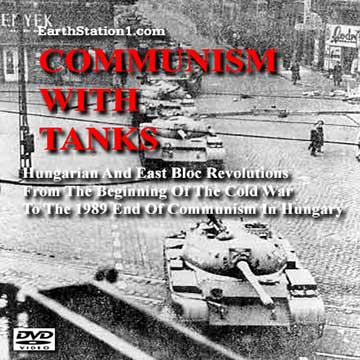
October 26, 1956: The Aftermath Of World
War II: The Cold War: The Eastern Bloc (The Communist Bloc, The
Socialist Bloc, The Soviet Bloc): Cold War Rebellions:
Anti-Communist Insurgencies In Central And Eastern Europe: The
Hungarian Revolution Of 1956 (The Hungarian Uprising): -- The
communist Hungarian People's Republic engages in shockingly brutal
and bloody repression of The Hungarian Uprising throughout the
country. In the towns of Mosonmagyarovar and Esztergom, Hungarian
secret police forces massacre civilians. As rebel strongholds in
Budapest hold, fighting spreads throughout the country. In the
town of Kecskemet, outside the office of State Security and the
local jail, Hungarian Army's Third Corps, led by Major General
Lajos Gyurko, shot seven anti-communist protestors and arrested
the organizers of the anti-Soviet protest. On Gyurko's orders,
Hungarian Air Force fighter planes shot up demonstrators with
cannon fire in various towns, earning the praise of Hungarian
communist leader and the General Secretary of the Hungarian
Socialist Workers' Party Janos Kadar, who after the defeat of the
"counter-revolution" called Gyorko "the only
division commander who, at the call of the party organisation,
swept the Danube-Tisza Interfluve six times, smashing everything".
The Hungarian Revolution Of 1956 (October 23 - November 10, 1956;
Hungarian: 1956-Os Forradalom), also known as the Hungarian
Uprising, was a countrywide revolution against the government of
the Hungarian People's Republic (1949-1989) and the Hungarian
domestic policies imposed by the Soviet Union (USSR). The
Hungarian Revolution began on October 23, 1956 in Budapest when
university students appealed to the civil populace to join them at
the Hungarian Parliament Building to protest against the USSR's
geopolitical domination of Hungary with the Stalinist government
of Matyas Rakosi. A delegation of students entered the building of
Hungarian Radio to broadcast their sixteen demands for political
and economic reforms to the civil society of Hungary, but they
were instead detained by security guards. When the student
protestors outside the radio building demanded the release of
their delegation of students, policemen from the AVH (Allamvedelmi
Hatosag) state protection authority shot and killed several
protestors. Consequently, Hungarians organized into revolutionary
militias to fight against the AVH; local Hungarian communist
leaders and AVH policemen were captured and summarily killed or
lynched; and anti-communist political prisoners were released and
armed. To realize their political, economic, and social demands,
the local soviets (councils of workers) assumed control of
municipal government from the Hungarian Working People's Party
(Magyar Dolgozok Partja). The new government of Imre Nagy
disbanded the AVH, declared the Hungarian withdrawal from the
Warsaw Pact, and pledged to re-establish free elections. By the
end of October the intense fighting had subsided. Although
initially willing to negotiate the withdrawal of the Soviet Army
from Hungary, the USSR repressed the Hungarian Revolution on 4
November 1956, and fought the Hungarian revolutionaries until
November 10; repression of the Hungarian Uprising killed 2,500
Hungarians and 700 Soviet Army soldiers, and compelled 200,000
Hungarians to seek political refuge abroad. On Sale @ 15% Off
Discount Till Midnight PT!
https://store.earthstation1.com/communism-with-tanks-dvd-hungarian-east-bloc-revolutions.html
Today's
EarthStation1.com 15% Off Commemorative Memorial Title: Civil Jets
The Boeing 707 C135 Stratolifter KC135 Tanker DVD, MP4, USB
Today, October 26, 2025
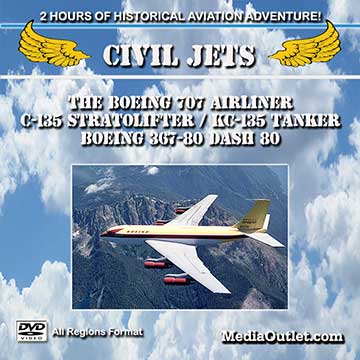
October 26, 1958: Aviation: The History
Of Aviation: The History Of Civil Aviation: Commercial Flights:
Maiden Commercial Flights: -- Pan American Airways makes the first
commercial flight of the Boeing 707 when it inaugurates such
flights as part of its regular commercial air service from New
York City to Paris. The Boeing 707 is an American long-range
narrow-body airliner that was developed and produced by Boeing
Commercial Airplanes, its first jetliner. Developed from the
Boeing 367-80, a prototype first flown in 1954, the initial
707-120 first flew on December 20, 1957. Pan American World
Airways began regular 707 service on October 26, 1958. The
airplane was built until 1979. A quadjet, the 707 has a swept wing
with podded engines. Its larger fuselage cross-section allowed
six-abreast economy seating, retained in the later 720, 727, 737,
and 757. Although it was not the first commercial jetliner in
service, the 707 was the first to be widespread and is often
credited with beginning the Jet Age. It dominated passenger air
transport in the 1960s, and remained common through the 1970s, on
domestic, transcontinental, and transatlantic flights, as well as
cargo and military applications. It established Boeing as a
dominant airliner manufacturer with its 7x7 series. The initial,
145-foot-long (44 m) 707-120 was powered by Pratt & Whitney
JT3C turbojet engines. The shortened long-range 707-138 and the
more powerful 707-220 entered service in 1959. The longer range,
heavier 707-300/400 series have a larger wing and are stretched
slightly by 8 feet (2.4 m). Powered by Pratt & Whitney JT4A
turbojets, the 707-320 entered service in 1959, and the 707-420
with Rolls-Royce Conway turbofans in 1960. The 720, a lighter
short-range variant, was also introduced in 1960. Powered by Pratt
& Whitney JT3D turbofans, the 707-120B debuted in 1961 and the
707-320B in 1962. The 707-120B typically flew 137 passengers in
two classes over 3,600 nmi (6,700 km), and could accommodate 174
in one class. With 141 passengers in two classes, the 707-320/420
could fly 3,750 nmi (6,940 km) and the 707-320B up to 5,000 nmi
(9,300 km). The 707-320C convertible passenger-freighter model
entered service in 1963, and passenger 707s have been converted to
freighter configurations. Military derivatives include the E-3
Sentry airborne reconnaissance aircraft and the C-137 Stratoliner
VIP transport. A total of 865 Boeing 707s were produced and
delivered, not including 154 Boeing 720s. On Sale @ 15% Off
Discount Till Midnight PT!
https://store.earthstation1.com/civil-jets-the-boeing-707-c135-stratolifter-kc135-t707135135.html
Today's
EarthStation1.com 15% Off Commemorative Memorial Title: Eyes On
The Prize II: America At The Racial Crossroads DVD MP4 USB
Today, October 26, 2025

October 26, 1960: Elections: Elections In
The United States: The 1960 United States Presidential Election:
Civil Rights Movements: The American Civil Rights Movement
(1954-1968): Anti-Black Racism In The United States:
Discrimination: The Sit-In Movement (The Sit-In Campaign, The
Student Sit-In Movement): The Atlanta Student Movement: The
Release Of Martin Luther King From Georgia State Prison: -- In a
daring political move that may well have tipped the 1960
presidential election in his favor, United States Presidential
candidate John F. Kennedy calls Coretta Scott King regarding her
husband Martin Luther King's arrest for participating in a sit-in
at Rich's Department Store to protest segregation; he then has his
brother Robert Kennedy arrange with the judge in the case for his
release from jail. The Atlanta Student Movement, formed in
February 1960 in Atlanta, Georgia by students of the campuses of
Atlanta University Center (AUC), a collaboration between four
historically black colleges and universities (HBCUs) in southwest
Atlanta, had been acting to desegregate businesses and public
spaces, organizing the Atlanta sit-ins from March 1960 onwards. In
August the movement asked King to participate in a mass October
sit-in, timed to highlight how 1960's Presidential election
campaigns had ignored civil rights. The coordinated day of action
took place on October 19. King participated in a sit-in at the
restaurant inside Rich's, Atlanta's largest department store, and
was among the many arrested that day. The authorities released
everyone over the next few days, except for King. Invoking his
probationary plea deal, judge J. Oscar Mitchell sentenced King on
October 25 to four months of hard labor. Before dawn the next day,
King was transported to Georgia State Prison. The arrest and harsh
sentence drew nationwide attention. Many feared for King's safety,
as he started a prison sentence with people convicted of violent
crimes, many of them White and hostile to his activism. Both
Presidential candidates were asked to weigh in, at a time when
both parties were courting the support of Southern Whites and
their political leadership including Governor Vandiver. Nixon,
with whom King had a closer relationship before, declined to make
a statement despite a personal visit from Jackie Robinson
requesting his intervention. Nixon's opponent John F. Kennedy
called the governor (a Democrat) directly, enlisted his brother
Robert to exert more pressure on state authorities, and, at the
personal request of Sargent Shriver, called King's wife to offer
his help. The pressure from Kennedy and others proved effective,
and King was released two days later. King's father decided to
openly endorse Kennedy's candidacy for the November 8 election
which he narrowly won. On Sale @ 15% Off Discount Till Midnight
PT!
https://store.earthstation1.com/eyes-on-the-prize-ii-dvd-set-4-discs-complete-2nd-seri42.html
Today's
EarthStation1.com 15% Off Commemorative Memorial Title: Muhammad
Ali Documentaries And Entire Fights DVD, Download, USB Drive
Today, October 26, 2025

October 26, 1970: Sports: The History Of
Sports: The History Of Sports In The United States: The History Of
Boxing: The History Of Heavyweight Boxing: Muhammad Ali vs. Jerry
Quarry I: -- Muhammad Ali faces off against Jerry Quarry in
Atlanta, Georgia for the first time after Ali's three-year hiatus
from evading to be drafted in the Vietnam War. Ali and Quarry
fought two boxing matches with each other. The first bout took
place on October 26, 1970; and the second on June 27, 1972. Ali
won both fights through technical knockouts. The first fight was
stopped in the third round; and the second in the seventh round.
On Sale @ 15% Off Discount Till Midnight PT!
https://store.earthstation1.com/muhammad-ali--dvd-2-discs-documentaries-and-entire-fight2.html
Today's
EarthStation1.com #OnThisDay Commemorative Memorial Title: The
Lone Ranger Radio Series MP3 Set DVD, Audio Download, USB Drive
Today, October 26, 2025
 October 26: National Mule Day: -- Today
we celebrate mules, a day that originated in the self-determined
mule capital of the world: Columbia, Tennessee. Mule Day can be
dated back to 1840. The day was originally referred to as
"Breeders Day." Since then, celebrations have spread
from Columbia Tennessee to global locations. The modern National
Mule Day began to shape into what we know today back in the 1930s
when a parade and other celebratory events were added to the
agenda. The mule happens to be the most common and earliest
man-made hybrid animal. The mule, instead of being an originally
wild animal that was domesticated by humans, was invented by
humans. It is the offspring of a male donkey and a female horse.
Donkeys and horses, it is important to note, are two entirely
different species with different numbers of chromosomes. Its
invention likely took place in ancient ages in modern-day Turkey.
Mules were fairly common in surrounding regions. They were
frequently used in Egypt by 3000 B.C. to carry cargo. Egyptian
common people also rode on mules as a form of transport. The mule
probably arrived in Asia Minor in 800 B.C. In ancient Rome, mules
were used for the transport of both humans and cargo. Their
strength and endurance were well-known by everyone - so much so
that when General Marius trained his soldiers to carry enormous
loads of ammunition, they were called 'Marius' Mules.' Christopher
Columbus brought mules to the Americas when he set out to discover
an alternate route to India and landed up in the Americas to
colonize them. Interestingly, George Washington - the first
American president - was called the father of the American mule
because he produced over 50 mules at his home. Washington
considered the mule important because they were docile and easy to
maintain. On Sale @ 15% Off Discount Till Midnight PT!
https://store.earthstation1.com/complete-lone-ranger-old-time-radio-shows-dual-layer-mp3-dv3.html
October 26: National Mule Day: -- Today
we celebrate mules, a day that originated in the self-determined
mule capital of the world: Columbia, Tennessee. Mule Day can be
dated back to 1840. The day was originally referred to as
"Breeders Day." Since then, celebrations have spread
from Columbia Tennessee to global locations. The modern National
Mule Day began to shape into what we know today back in the 1930s
when a parade and other celebratory events were added to the
agenda. The mule happens to be the most common and earliest
man-made hybrid animal. The mule, instead of being an originally
wild animal that was domesticated by humans, was invented by
humans. It is the offspring of a male donkey and a female horse.
Donkeys and horses, it is important to note, are two entirely
different species with different numbers of chromosomes. Its
invention likely took place in ancient ages in modern-day Turkey.
Mules were fairly common in surrounding regions. They were
frequently used in Egypt by 3000 B.C. to carry cargo. Egyptian
common people also rode on mules as a form of transport. The mule
probably arrived in Asia Minor in 800 B.C. In ancient Rome, mules
were used for the transport of both humans and cargo. Their
strength and endurance were well-known by everyone - so much so
that when General Marius trained his soldiers to carry enormous
loads of ammunition, they were called 'Marius' Mules.' Christopher
Columbus brought mules to the Americas when he set out to discover
an alternate route to India and landed up in the Americas to
colonize them. Interestingly, George Washington - the first
American president - was called the father of the American mule
because he produced over 50 mules at his home. Washington
considered the mule important because they were docile and easy to
maintain. On Sale @ 15% Off Discount Till Midnight PT!
https://store.earthstation1.com/complete-lone-ranger-old-time-radio-shows-dual-layer-mp3-dv3.html
Today's
EarthStation1.com #OnThisDay Commemorative Memorial Title: The War
In Korea 2 Part TV Series w/ Kirk Douglas DVD, MP4, USB Drive
Today, October 26, 2025
October 26: National Day Of The
Deployed:-- Our day to say "Thank You" to all military
serving outside the US and to their families who keep things
running at home in their absence It's hard to imagine a more
challenging military assignment than one taking our servicemen and
women to countries all over the world, far away from home. Unless
you know someone currently serving outside the US, the sacrifices
they make throughout deployment are difficult to comprehend. Read
on for some simple ways to recognize, support, and encourage our
amazing U.S. troops. National Day of the Deployed dates back to
2006 when Shelle Michaels Aberle approached then North Dakota
Governor John Hoeven to support a proclamation for a day to honor
those men and women actively serving in the military outside the
U.S. Hoeven was the first governor in the United States to
recognize deployed troops through a formal proclamation. October
26 was chosen as the annual date of observance because it was the
birthday of Aberle's cousin, U.S. Army Lt. Col. David Hosna,
actively serving in Iraq at the time. In 2011, Hoeven, then a U.S.
senator, sponsored a resolution designating October 26 as National
Day of the Deployed, which passed unanimously. Since then, all 50
states have officially observed the holiday. Deployments can last
anywhere from 90 days to 15 months. Having a loved one actively
serving a deployment brings numerous challenges. Extended periods
of time away from home and not knowing where your loved one may be
are just a couple of the stressors. Today, take a moment to
remember, honor and thank the dedication our deployed military
displays for our country. On Sale @ 15% Off Discount Till Midnight
PT!
https://store.earthstation1.com/the-war-in-korea-dvd-2-part-tv-series-2-dis22.html
Today's
EarthStation1.com #OnThisDay Commemorative Memorial Title: Bank Of
Crooks & Criminals The BCCI Scandal DVD MP4 Download USB Drive
Today, October 26, 2025
October 26: National Financial Crime
Fighter Day: -- National Financial Crime Fighter Day is celebrated
on October 26 every year. The objective of the day is to celebrate
anti-money laundering (A.M.L.) professionals and the good their
work does to the financial institutions of the United States. The
first-ever National Financial Crime Fighter Day was held in 2017.
It was organized by Abrigo, a risk management and growth driving
technological platform used by financial institutions in America,
to honor A.M.L. professionals and acknowledge the extremely
important work that they do. As per Bob Kim, vice president of
client and partner solutions at Abrigo, "We are proud to
continue to push for more awareness and recognition of these
unsung superheroes." In the same vein, the Bank Secrecy Act
(B.S.A.) was also passed to control financial crimes. A rise in
the drug trade in the 1960s and 1970s led to a large influx of
illegal money supply into the U.S. financial system. In
retaliation to the inflow, the U.S. Congress passed the Bank
Secrecy Act in 1970 to curtail money laundering and financial
crimes. This resolve was further strengthened after the terrorist
attacks on September 11, 2001. The resulting U.S.A. PATRIOT Act,
2001 - signed on October 26, 2001 - cemented the importance of
B.S.A./A.M.L. professionals in the U.S. financial system.
B.S.A./A.M.L. professionals have been working, for over half a
century now, to prevent money-laundering and other financial
crimes in the country. As per Bob Kim, vice president of client
and partner solutions at Abrigo, "B.S.A. and A.M.L.
professionals work tirelessly to protect our financial system from
money laundering, fraud, and other financial crimes." He
holds that the hard work that these professionals put into their
craft often goes unrecognized outside of the industry. He added,
"We are happy to help shine the national light on their
unrelenting dedication to their occupation with National Financial
Crime Fighter Day." This reverence of B.S.A./A.M.L.
professionals is displayed especially on National Financial Crime
Fighter Day every year on the anniversary of the U.S.A. PATRIOT
Act is signed. On Sale @ 15% Off Discount Till Midnight PT!
https://store.earthstation1.com/bank-of-crooks-amp-criminals-the-bcci-scandal-dvd-mp4-download-usb-driv4.html
Today's
EarthStation1.com #OnThisDay Commemorative Memorial Title: Vienna
Is Different: 50 Years After The Anschluss DVD, MP4, USB Drive
Today, October 26, 2025
October 26: Austrian National Day: -- It
has been 56 years since this day was declared an official holiday.
Did you know, on this day, Austria adopted the Federal
Constitutional Law on the Neutrality of Austria? This is the day
on which Austria stated its neutrality and decided that it will
not be involved in any military alliances and won't allow any
military bases to be established in its territory. This day is
also celebrated as Day of the Austrian Flag and declares the
re-establishment of Austria's sovereignty after World War II. This
decision for Neutrality became part of the national consciousness
of the Austrians. Austrian National Day has been celebrated since
1955, commemorating the day Austria signed a Declaration of
Neutrality. This decision was an announcement by the Parliament of
Austria to declare Austria as neutral. The declaration was adopted
as a constitutional act of parliament. The declaration was a
result of the joint occupation of Austria by France, the United
Kingdom, the United States, and the Soviet Union during 1945 and
1955. It is known that if Austria had not declared its neutrality
following the withdrawal of the allied forces from the country,
the Soviet Union would not have signed the Austrian State Treaty
in May 1955. On October 25, 1955, the remaining foreign troops
left Austria. The element of neutrality has become ingrained in
the identity of Austrians since 1955. It is an essential part of
Austria's constitution and international law. Since Austria is a
member of the European Union, there had been some debate whether
Austria would remain neutral or whether it would change its
neutral status. After the end of the Second World War, the four
allied forces occupied Austria and divided it into four regions.
The Austrian parliament was democratically elected but every
government decision was approved by the allied forces before the
decision was taken. After the Austrian State Treaty was signed on
May 15, 1955, it put an end to the occupation of the Allied
forces. On Sale @ 15% Off Discount Till Midnight PT!
https://store.earthstation1.com/vienna-is-different-50-years-after-the-anschluss-dvd-mp4-504.html
Today's
EarthStation1.com #OnThisDay Commemorative Memorial Title: Legacy
With Michael Wood World History TV Series DVD, MP4, USB Stick
Today, October 26, 2025
October 26: Accession Day (India): --
Marks the anniversary, first announced as a public holiday in
2020, of Maharaja Hari Singh signing "The Instrument Of
Accession" with the Government of India, cementing his
princely state of Jammu And Kashmir as a member of the Dominion of
India, but sparking thereby the Indo-Pakistani War of 1947-1948
and the Kashmir Conflict; while those in Jammu And Kashmir whose
nationalist sentiments favor India celebrate the day by lighting
fireworks, singing the Indian national anthem and hoisting the
Indian flag, those who with separatist aspirations observe the day
as a "Black Day" of mourning of the loss of Kashmir's
independence. Jammu And Kashmir has a long and rich history. The
area has been inhabited by humans since the Neolithic period in
3000 B.C. Since then, the people of Jammu And Kashmir have lived
under the rule of many monarchs - the Uttara-Kurus, the Maurya
Empire, the Karkota Empire, the Mughals, and the Sikhs, among
others. The princely state of Jammu And Kashmir Jammu And Kashmir
was torn apart when British India was partitioned to form the
modern nations of India and Pakistan. When Pakistani forces
launched a guerrilla attack on Kashmir in 1947, Hari Singh, the
reigning monarch of Kashmir at the time, turned to Mountbatten and
India. He was asked to sign the Instrument of Accession - a
document declaring the princely state as part of the Dominion of
India. After the first Indo-Pakistan War drew to an end, the
United Nations was called for mediation. The U.N.'s suggestion to
hold a referendum to discern the aspirations of the Kashmiri
people was refused by India. Jammu And Kashmir, thus, became a
part of the Union of India. The state was accorded special status
by Article 370 of the Indian Constitution. The article, though,
was repealed in 2019 and the state of Jammu And Kashmir was split
into two Union Territories of Jammu And Kashmir, and Ladhak. On
Sale @ 15% Off Discount Till Midnight PT!
https://store.earthstation1.com/legacy-with-michael-wood-world-history-tv-series-dvd-mp4-us4.html
Today's
EarthStation1.com #OnThisDay Commemorative Memorial Title: The Age
Of The Enlightenment TV College Course DVD, Download, USB
Today, October 26, 2025
October 26, 1764: #DOTD: #RIP: William
Hogarth FRSA, English painter, illustrator, critic, printmaker,
pictorial satirist, social critic, and editorial cartoonist, by
far the most significant English artist of his generation (b.
November 10, 1697) #dies aged 66. On October 25, 1764, Hogarth was
conveyed from his villa in Chiswick to his home in Leicester
Fields, in weak condition. He had been in a weakened state for a
while by this time, but was said to be in a cheerful mood and was
even still working -- with some help; doing more retouches on The
Bench on this same day. On October 26, he received a letter from
Benjamin Franklin and wrote up a rough draft in reply before going
to bed that evening, he had boasted about eating a pound of
beefsteaks for dinner, and reportedly looked more robust than he
had in a while at this time. However, when he went to bed, he
suddenly began vomiting; something that caused him to ring his
bell so forcefully that it broke. Hogarth died around two hours
later, in the arms of his servant, Mrs Mary Lewis. John Nichols
claimed that he died of an aneurysm, which he said took place in
the "chest." Horace Walpole claimed that he died of "a
dropsy of his breast." Mrs Lewis, who stayed on with Jane
Hogarth in Leicester Fields, was the only non-familial person
acknowledged financially in Hogarth's will and was left 100PS
(approximately 15,236.79PS in 2024 for her "faithful
services." Hogarth is buried at St. Nicholas Church,
Chiswick, now in the west of London. His friend, actor David
Garrick, composed the following inscription for his tombstone:
========= Farewell great Painter of Mankind | Who reach'd the
noblest point of Art | Whose pictur'd Morals charm the Mind | And
through the Eye correct the Heart. | If Genius fire thee, Reader,
stay, | If Nature touch thee, drop a Tear: | If neither move thee,
turn away, | For Hogarth's honour'd dust lies here. =========
William Hogarth was born at Bartholomew Close in London. His work
ranged from realistic portraiture to comic strip-like series of
pictures called "modern moral subjects", perhaps best
known being his moral series A Harlot's Progress, A Rake's
Progress and Marriage A-la-Mode. Knowledge of his work is so
pervasive that satirical political illustrations in this style are
often referred to as "Hogarthian". Hogarth's works are
mostly satirical caricatures, sometimes bawdily sexual, mostly of
the first rank of realistic portraiture. They became widely
popular and mass-produced via prints in his lifetime.
#WilliamHogarth #Painters #Illustrators #Critics #Printmakers
#PolitcalSatire #Cartoonists #MP4 #VideoDownload #DVD On Sale @
15% Off Discount Till Midnight PT!
https://store.earthstation1.com/the-age-of-enlightenment-5-episodes-tv-college-course-2-dv52.html
Today's
EarthStation1.com #OnThisDay Commemorative Memorial Title: The
World: A Television History Documentary Series DVD, Download, USB
Today, October 26, 2025
October 26, 1860: Italy: The History
Italy: The Unification Of Italy (Italian: Risorgimento): The
Kingdom Of Italy: The Proclamation Of The Kingdom Of Italy:
Anniversary Of The Unification Of Italy (Italian: Anniversario
Dell'Unita D'Italia): The Second Italian War Of Independence: The
Campaign Of 1860: The Expedition Of The Thousand (Italian:
Spedizione Dei Mille): -- An 1860 Italian military expedition of a
corps of volunteers, led by Giuseppe Garibaldi, that sailed from
Quarto near Genoa (now Quarto dei Mille), landed in Marsala,
Sicily, and fought to conquer the Kingdom of the Two Sicilies,
ruled by the House of Bourbon-Two Sicilies, ends in victory when
Giuseppe Garibaldi presents his conquests to King Victor Emmanuel
of Sardinia. The Expedition Of The Thousand was an ambitious and
risky venture aiming to conquer, with a thousand men, a kingdom
with a larger regular army and a more powerful navy. The
expedition was a success and concluded with a plebiscite that
brought Naples and Sicily into the Kingdom of Sardinia, the last
territorial conquest before the proclamation of the Kingdom of
Italy on March 17, 1861. The sea venture was the only desired
action that was jointly decided by the "four fathers of the
nation" Giuseppe Mazzini, Giuseppe Garibaldi, Victor Emmanuel
II, and Camillo Cavour, pursuing divergent goals. However, the
Expedition was instigated by Francesco Crispi, who utilized his
political influence to bolster the Italian unification project.
The various groups participated in the expedition for a variety of
reasons: for Garibaldi, it was to achieve a united Italy; to the
Sicilian bourgeoisie, an independent Sicily as part of the kingdom
of Italy, and for common people, land distribution and the end of
oppression. The expedition and the whole enterprise was heavily
supported by the British, who wanted to establish a friendly
government in Southern Italy, which was becoming of great
strategic value because of the imminent opening of the Suez Canal.
The Bourbons were considered unreliable due to their increasing
openings towards the Russian Empire. The Royal Navy defended the
landing party from the Bourbons and donors from the United Kingdom
supported the expedition financially with large part of the money
being used to bribe disloyal Bourbon military officers. On Sale @
15% Off Discount Till Midnight PT!
https://store.earthstation1.com/the-world-a-television-history-4-dual-layer-dvds-all-26-sh426.html
Today's
EarthStation1.com #OnThisDay Commemorative Memorial Title:
Appointment With Destiny: Showdown At O.K. Corral DVD, Download,
USB
Today, October 26, 2025
October 26, 1881: The American Frontier
(The American West, The Wild West, The Old West): Gunfights
(Shootouts, Firefights, Gun Battles): The Gunfight At The O.K.
Corral: -- At about 3:00 p.m. on a Wednesday, the famous Gunfight
At The O.K. Corral occurs in Tombstone, Arizona Territory during a
30-second shootout between lawmen Wyatt Earp, his two brothers
Virgil and Morgan, and "Doc" Holliday, and the feuding
Clanton family members of a loosely organized group of outlaws
called the Cowboys (the Cochise County Cowboys). Virgil and Morgan
Earp were wounded, and Holliday grazed by bullet; Tom and Frank
McLaury and Billy Clanton were killed. The lawmen were led by
Virgil Earp, and the gunfight is generally regarded as the most
famous shootout in the history of the American Wild West. The
gunfight was the result of a long-simmering feud, with Cowboys
Billy Claiborne, Ike and Billy Clanton, and Tom and Frank McLaury
on one side; and Town Marshal Virgil Earp, Special Policemen
Morgan and Wyatt Earp, and temporary policeman Doc Holliday on the
other side. Billy Clanton and both McLaury brothers were killed.
Ike Clanton, Billy Claiborne, and Wes Fuller ran from the fight.
Virgil, Morgan, and Holliday were wounded, but Wyatt was unharmed.
Wyatt is often erroneously regarded as the central figure in the
shootout, although his brother Virgil was Tombstone town marshal
and Deputy U.S. Marshal that day and had far more experience as a
sheriff, constable, marshal, and soldier in combat. The shootout
has come to represent a period of the American Old West when the
frontier was virtually an open range for outlaws, largely
unopposed by law enforcement officers who were spread thin over
vast territories (some modern writers consider such outlaw
organizations as the Chochise County Cowboys as one of the first
and earliest forms of organized crime syndicates in American
history). The gunfight was not well known to the American public
until 1931, when Stuart Lake published the initially well-received
biography Wyatt Earp: Frontier Marshal two years after Earp's
death. The book was the basis for the 1946 film My Darling
Clementine, directed by John Ford, and the 1957 film Gunfight at
the O.K. Corral, after which the shootout became known by that
name. Since then, the conflict has been portrayed with varying
degrees of accuracy in numerous Western films and books, and has
become an archetype for much of the popular imagery associated
with the Old West. Despite its name, the gunfight did not take
place within or next to the O.K. Corral, which fronted Allen
Street and had a rear entrance lined with horse stalls on Fremont
Street. The shootout actually took place in a narrow lot on the
side of C. S. Fly's Photographic Studio on Fremont Street, six
doors west of the O.K. Corral's rear entrance. Some members of the
two opposing parties were initially only about 6 feet (1.8 m)
apart. About 30 shots were fired in 30 seconds. Ike Clanton
subsequently filed murder charges against the Earps and Holliday.
After a 30-day preliminary hearing and a brief stint in jail, the
lawmen were shown to have acted within the law. The gunfight was
not the end of the conflict. On December 28, 1881, Virgil Earp was
ambushed and maimed in a murder attempt by the Cowboys. On March
18, 1882, a Cowboy fired from a dark alley through the glass door
of Campbell & Hatch's saloon and billiard parlor, killing
Morgan Earp. The suspects in both incidents furnished alibis
supplied by other Cowboys and were not indicted. Wyatt Earp, newly
appointed as Deputy U.S. Marshal in Cochise County, then took
matters into his own hands in a personal vendetta. He was pursued
by county sheriff Johnny Behan, who had received a warrant from
Tucson for Wyatt's killing of Frank Stilwell. On Sale @ 15% Off
Discount Till Midnight PT!
https://store.earthstation1.com/appointment-with-destiny-showdown-at-ok-corral-dvd.html
Today's
EarthStation1.com #OnThisDay Commemorative Memorial Title: The
Great War (1964) TV Documentary Series DVD, Video Download, USB
Today, October 26, 2025
October 26, 1918: The European Civil War:
World War I: The First European War (The European Theater Of World
War I): The Western Front Of World War I: The Dismissal Of
Quartermaster General Erich Ludendorff: -- Erich Ludendorff, First
Quartermaster General Of The Great General Staff Of The Imperial
German Army, is curtly dismissed by Kaiser Wilhelm II for refusing
to cooperate in peace negotiations. On July 18, 1918, Ludendorff,
still aggressive, confident and undeterred following the Germans
failure in their strike near Reims at the hends of brilliant
French elastic tactics, traveled to Flanders to confer about the
next attack there. A telephone call reported that the French and
Americans, led by a mass of tanks, had smashed through the right
flank of their salient pointing toward Paris, on the opening day
of the Battle of Soissons. Everyone present realized that surely
they had lost the war. Ludendorff was shattered. The Oberste
Heeresleitung (OHL), the German Supreme Army Command, began to
withdraw step by step to new defensive lines, first evacuating all
of their wounded and supplies. Ludendorff's communiques, which
hitherto had been largely factual, now distorted the news, for
instance claiming that American troops had to be herded onto troop
ships by special police. On August 8, 1918, the Germans were
completely surprised at Amiens when British tanks broke through
the defenses and intact German formations surrendered. To
Ludendorff it was the "black day in the history of the German
Army". The German retreats continued, pressed by Allied
attacks. OHL still vigorously opposed offering to give up the
territory they desired in France and Belgium, so the German
government was unable to make a plausible peace proposal.
Ludendorff became increasingly cantankerous, railing at his staff
without cause, publicly accusing Hindenburg of talking nonsense,
and sometimes bursting into tears. Bauer wanted him replaced, but
instead a doctor, Oberstabarzt Hochheimer, was brought to OHL. He
had worked closely with Ludendorff in Poland during the winter of
1915-16 on plans to bring in German colonists. Before the war he
had a practice in nervous diseases. Hochheimer "spoke as a
friend and he listened as a friend", convincing Ludendorff
that he could not work effectively with one hour of sleep a night
and that he must relearn how to relax. After a month away from
headquarters Ludendorff had recovered from the severest symptoms
of battle fatigue. On September 29, 1918, Ludendorff and
Hindenburg had suddenly told an incredulous Kaiser that they could
not guarantee the integrity of the Western front "for two
hours" and they must have an immediate armistice. A new
Chancellor, Prince Maximilian of Baden, approached President
Woodrow Wilson, but Wilson's terms were unacceptable to the German
leadership, and so the German army fought on. The chancellor told
the Kaiser that he and his cabinet would resign unless Ludendorff
was removed, but that Hindenburg must remain to hold the army
together. The Kaiser called his commanders in, curtly accepting
Ludendorff's resignation and then rejecting Hindenburg's. Fuming,
Ludendorff would not accompany the field marshal back to
headquarters: "I refused to ride with you because you have
treated me so shabbily". Ludendorff had assiduously sought
all of the credit; now he was rewarded with all of the blame.
Widely despised, and with revolution breaking out, he was hidden
by his brother and a network of friends until he slipped out of
Germany disguised in blue spectacles and a false beard and fake
Finnish passport, settling in a Swedish admirer's country home
until the Swedish government asked him to leave in February 1919.
Within seven months, he wrote two volumes of detailed memoirs.
Friends, led by Breucker, provided him with documents and
negotiated with publishers. Groener (who is not mentioned in the
book) characterized it as a showcase of his "caesar-mania".
He was a brilliant general, according to John Wheeler-Bennett,
stating that he was "certainly one of the greatest routine
military organizers that the world has ever seen", but he
also said he was a ruinous political meddler. The influential
German military analyst Hans Delbruck November 11. 1848 - July 14,
1929 concluded that "The Empire was built by Moltke and
Bismarck, destroyed by Tirpitz and Ludendorff." On Sale @ 15%
Off Discount Till Midnight PT!
https://store.earthstation1.com/the-great-war-dvd-set-1964-wwi-tv-series-26-shows-1964266.html
Today's
EarthStation1.com #OnThisDay Commemorative Memorial Title: The
Chopper In Peace & War: Helicopter History MP4 Video Download
DVD
Today, October 26, 2025
October 26, 1972: #DOTD: #RIP: Igor
Sikorsky, Ukrainian-American engineer and academic, inventor of
the modern helicopter, founded Sikorsky Aircraft (b. May 25, 1889)
#dies at his home in Easton, Connecticut, and is buried in Saint
John the Baptist Russian Orthodox Cemetery located on Nichols
Avenue in Stratford. Igor Sikorsky was born Igor Ivanovich Sikorsk
in Kiev, Russian Empire (now Kyiv, Ukraine). He was an aviation
pioneer in both helicopters and fixed-wing aircraft. He began
designing and constructing airplanes as a young man in Russia at
the dawn of the age of flight After immigrating to the United
States in 1919 following the Bolshevik Revolution, Sikorsky
founded the Sikorsky Aircraft Corporation in 1923, and developed
the first of Pan American Airways ocean-conquering flying boats in
the 1930s. In 1939, Sikorsky designed and flew the Vought-Sikorsky
VS-300, the first viable American helicopter, which pioneered the
rotor configuration used by most helicopters today. Sikorsky
modified the design into the Sikorsky R-4, which became the
world's first mass-produced helicopter in 1942. On Sale @ 15% Off
Discount Till Midnight PT!
https://store.earthstation1.com/the-chopper-dvd-helicopter-history-documentary.html
Today's
EarthStation1.com #OnThisDay Commemorative Memorial Title: Russian
Right Stuff: Soviet Space Program TV Series DVD, Download, USB
Today, October 26, 2025
October 26, 1968: Rocket Launches: The
History Of Rocketry: The History Of Spaceflight: The Aftermath Of
World War II: The Cold War: The Space Age: The Space Race: The
Soviet Space Program: Human Spaceflight Programs: The Soyuz
Programme: Soyuz 3 (Russian: Union 3): -- The first Soviet space
rendezvous occurs after the Soyuz 3 space mission launches its
Soyuz 7K-OK No.3 spacecraft at 08:34:18 GMT from Baikonur
Cosmodrome's Launch Site 31/6 atop a Soyuz Rocket. Flown by Georgy
Beregovoy, the Soyuz spacecraft completed 81 orbits over four
days. The 47-year-old Beregovoy was a decorated World War II
flying ace and the oldest person to go into orbit up to that time.
The mission achieved the first Russian space rendezvous with the
uncrewed Soyuz 2, but failed to achieve a planned docking of the
two craft. On Sale @ 15% Off Discount Till Midnight PT!
https://store.earthstation1.com/russian-right-stuff-dvd-set-space-program-secret-history-2-disc2.html
Today's
EarthStation1.com #OnThisDay Commemorative Memorial Title: Unknown
Chaplin (1983) Charlie Chaplin TV Series DVD, Download, USB
Today, October 26, 2025
October 26, 1914: #BOTD: #HBD! Jackie
Coogan, American actor, comedian and director (d. March 1, 1984)
is #born John Leslie Coogan in Los Angeles, California. He began
his movie career as a child actor in silent films. Charlie
Chaplin' film classic The Kid (1921) made him one of the first
child stars in film history. He later sued his mother and
stepfather over their squandering his film earnings, and provoked
California to enact the first known legal protection for the
earnings of child performers, widely known as the Coogan Act.
Coogan continued to act throughout his life, later earning renewed
fame in middle age portraying Uncle Fester in the 1960s TV series
The Addams Family. Jackie Coogan #died at Santa Monica Hospital in
Santa Monica, California, aged 69, when after a long history of
heart trouble and hypertension and having had several strokes
previously, his blood pressure dropped undergoing kidney dialysis
and died from cardiac arrest. At Coogan's request, his funeral was
open to the public and was attended by several fans. John Astin,
Coogan's co-star from The Addams Family, delivered the eulogy.
Coogan is interred at Holy Cross Cemetery in Culver City. His star
on the Hollywood Walk of Fame is located at 1654 Vine Street, just
south of Hollywood Boulevard. He was born John Leslie Coogan in
Los Angeles, California. He began his movie career as a child
actor in silent films. Charlie Chaplin' film classic The Kid
(1921) made him one of the first child stars in film history. He
later sued his mother and stepfather over their squandering his
film earnings, and provoked California to enact the first known
legal protection for the earnings of child performers, widely
known as the Coogan Act. Coogan continued to act throughout his
life, later earning renewed fame in middle age portraying Uncle
Fester in the 1960s TV series The Addams Family. On Sale @ 15% Off
Discount Till Midnight PT!
https://store.earthstation1.com/unknown-chaplin-tv-miniseries-1983-dvd-2-19832.html
Today's
EarthStation1.com #OnThisDay Commemorative Memorial Title: Vietnam
War & AFVN Radio MP3 Set MPG & JPG Set CD, Download, USB
Drive
Today, October 26, 2025
October 26, 1946: #BOTD: #HBD! Pat Sajak,
American journalist, actor, radio personality, weatherman, talk
show host and game show host is #born Patrick Leonard Sajdak in
Chicago, Illinois. He is best known as the host of the American
television game show Wheel of Fortune. For his work on Wheel,
Sajak has received 19 nominations for the Daytime Emmy Award for
Outstanding Game Show Host, winning three times. He served in
uniform as a disc jockey during the Vietnam War for American
Forces Vietnam Network. On Sale @ 15% Off Discount Till Midnight
PT!
https://store.earthstation1.com/vietnam-war-cdrom-mp3s-mpgs-jpgs-cdro3.html
Today's
EarthStation1.com #OnThisDay Commemorative Memorial Title: The
Movie Life Of George: George Harrison's HandMade Films DVD MP4 USB
Today, October 26, 2025
October 26, 1942: #BOTD: #HBD! Bob
Hoskins, English actor, singer, and director (d. April 29, 2014)
is #born Robert William Hoskins in Bury St Edmunds, a historic
market, cathedral town and civil parish in Suffolk, England. His
work included lead roles in films and television series such as
Pennies from Heaven (1978), The Long Good Friday (1980), Mona Lisa
(1986), Who Framed Roger Rabbit (1988), Mermaids (1990), and Super
Mario Bros. (1993), and supporting performances in Brazil (1985),
Hook (1991), Nixon (1995), Enemy at the Gates (2001), Mrs
Henderson Presents (2005), A Christmas Carol (2009), Made in
Dagenham (2010), and Snow White and the Huntsman (2012). He also
directed two feature films: The Raggedy Rawney (1988) and Rainbow
(1996). Hoskins received the Best Actor Award at the Cannes Film
Festival, the BAFTA Award for Best Actor in a Leading Role and the
Golden Globe Award for Best Actor - Motion Picture Drama for his
role in Mona Lisa. He was also nominated for the Academy Award for
Best Actor for the same role. In 2009, he won an International
Emmy Award for Best Actor for his appearance on the BBC One drama
The Street. He retired from acting in 2012 owing to Parkinson's
disease, with which he had been diagnosed the previous year, and
died of pneumonia at the age of 71. He had retired from acting in
2012 owing to Parkinson's disease, with which he had been
diagnosed the previous year. Hoskins is buried in Highgate
Cemetery in London. On Sale @ 15% Off Discount Till Midnight PT!
https://store.earthstation1.com/the-movie-life-of-george-handmade-films-dvd-mp4-us4.html
Today's
EarthStation1.com #OnThisDay Commemorative Memorial Title: The
Shah Of Iran Mohammad Reza Pahlavi + Bonus MP4 Download DVD
Today, October 26, 2025
October 26, 1919: #BOTD: Mohammad Reza
Pahlavi, also known as Mohammad Reza Shah, who due to his status
as the last Shah (King) of Iran is often known as simply "The
Shah", Shah of the Imperial State of Iran from September 16,
1941 until his overthrow in the Iranian Revolution on February 11,
1979 (d. July 27, 1980) is #born in Tehran, Sublime State of
Persia (modern Iran). Mohammad Reza Shah, who took the title
Shahanshah ("King of Kings") on October 26, 1967, was
the second and last monarch of the House of Pahlavi. Mohammad Reza
Shah Pahlavi held several other titles, including that of Aryamehr
("Light of the Aryans") and Bozorg Arteshtaran
("Commander-In-Chief"). His dream of what he referred to
as a "Great Civilisation" in Iran led to a rapid
industrial and military modernisation, as well as economic and
social reforms. Mohammad Reza came to power during World War II
after the 1941 Anglo-Soviet invasion codenamed Operation
Countenance forced the abdication of his father, Reza Shah
Pahlavi. During Mohammad Reza's reign, the British owned oil
industry was briefly nationalised, under Prime Minister Mohammad
Mosaddegh, until a UK and US -backed coup deposed Mosaddegh and
brought back foreign oil firms under the Consortium Agreement of
1954. Under Mohammad Reza's reign, Iran marked the anniversary of
2,500 years of continuous Persian monarchy since the founding of
the Achaemenid Empire by Cyrus the Great - concurrent with this
celebration, Mohammad Reza changed the benchmark of the Iranian
calendar from the hegira to the beginning of the First Persian
Empire, measured from Cyrus the Great's coronation. Mohammad Reza
also introduced the White Revolution, a series of economic, social
and political reforms with the proclaimed intention of
transforming Iran into a global power and modernising the nation
by nationalising certain industries and granting women suffrage.
Mohammad Reza gradually lost support from the Shi'a clergy of Iran
as well as the working class, particularly due to his strong
policy of modernisation, lsecularity, conflict with the
traditional class of wealthy merchants known as bazaaris,
relations with Israel, and corruption issues surrounding himself
and the royal family, and the ruling elite. Various additional
controversial policies were enacted, including the banning of
Communism and Marxism-Leninism including the Tudeh Party and a
general suppression of political dissent by Iran's intelligence
agency, SAVAK. According to official statistics, Iran had as many
as 2,200 political prisoners in 1978, a number which multiplied
rapidly as a result of the revolution. Several other factors
contributed to strong opposition to the Shah amongst certain
groups within Iran, the most significant of which were US and UK
support for his regime, and clashes with leftists and Islamists.
By 1979, political unrest had transformed into a revolution which,
on 17 January, forced him to leave Iran. Soon thereafter, the
Iranian monarchy was formally abolished, and Iran was declared an
Islamic republic led by Ruhollah Khomeini (known in the West as
Ayatollah Khomeini). Facing likely execution should he return to
Iran, he died in exile in Egypt, whose president, Anwar Sadat, had
granted him asylum. Mohammad Reza Pahlavi died in exile in Cairo,
Egypt at 9:15 AM aged 60 from complications of a splenectomy, the
surgical partial or complete removal of the spleen, performed by
the emininent surgeon Michael DeBakey, who though world-renowned
in his field, was limited in his experience performing this
surgery. When the splenectomy was being performed, the tail of the
pancreas was injured. This led to infection and the subsequent
death of the Shah in the following days. The Shah was asked to
describe in his hospital bed his feelings for Iran and its people
and to define the country. The Shah, a fervent nationalist,
responded "Iran is Iran." After pausing for minutes, he
said "Its land, people, and history," and "Every
Iranian has to love it." He continued on to repeat "Iran
is Iran" over and over. Shortly after, the Shah slipped into
a coma and died. He kept a bag of Iranian soil under his death
bed. Egyptian President Sadat gave the Shah a state funeral;
having faced likely execution in Iran, Anwar Sadat had granted The
Shah asylum in Egypt. In addition to members of the Pahlavi
family, Anwar Sadat, Richard Nixon and Constantine II of Greece
attended the funeral ceremony in Cairo. Mohammad Reza Shah is
buried in the Al Rifa'i Mosque in Cairo, a mosque of great
symbolic importance. Also buried there is Farouk of Egypt,
Mohammad Reza Shah's former brother-in-law. The tombs lie to the
left of the entrance. Years earlier, his father and predecessor,
Reza Shah, had also initially been buried at the Al Rifa'i Mosque.
On Sale @ 15% Off Discount Till Midnight PT!
https://store.earthstation1.com/mohammad-reza-pahlavi-the-politics-of-oil-shah-of-iran--dvd.html
Today's
EarthStation1.com #OnThisDay Commemorative Memorial Title: Edward
R. Murrow: This Reporter TV Series DVD, Download, USB Drive
Today, October 26, 2025
October 26, 1990: #DOTD: #RIP: William S.
Paley, American broadcaster, founded CBS (b. September 28, 1901)
#dies of kidney failure in New York City, less than a month after
his 89th birthday. He is buried at the Memorial Cemetery of St.
John's Episcopal Church. William Samuel Paley was the chief
executive who built the Columbia Broadcasting System (CBS) from a
small radio network into one of the foremost radio and television
network operations in the United States. Paley was born in
Chicago, Illinois, the son of Goldie (Drell) and Samuel Paley. His
family was Jewish, and his father was an immigrant from Ukraine
who ran a cigar company. As the company became increasingly
successful, Paley became a millionaire, and moved his family to
Philadelphia in the early 1920s. William Paley matriculated at
Western Military Academy in Alton, Illinois and later received his
college degree from the Wharton School at the University of
Pennsylvania in expectation that he would take an increasingly
active role running the family cigar business. In 1927, Paley's
father, Leon Levy (Leon Levy was married to Paley's sister,
Blanche), and some business partners bought a struggling
Philadelphia-based radio network of 16 stations called the
Columbia Phonographic Broadcasting System. Samuel Paley's
intention was to use his acquisition as an advertising medium for
promoting the family's cigar business, which included the La
Palina brand. Within a year, under William's leadership, cigar
sales had more than doubled, and, in 1928, the Paley family
secured majority ownership of the network from their partners. By
September 1928, Paley bought out the Louchhheim share of CBS and
became its majority owner with 51% of the business. During
Louchheim's brief regime, Columbia paid 410K USD to A.H. Grebe's
Atlantic Broadcasting Company for a small Brooklyn station, WABC
(no relation to the current WABC), which would become the
network's flagship station. WABC was quickly upgraded, and the
signal relocated to 860 kHz. The physical plant was relocated also
- to Steinway Hall on West 57th Street in Manhattan, where much of
CBS's programming would originate. By the turn of 1929, the
network could boast to sponsors of having 47 affiliates. Paley
moved right away to put his network on a firmer financial footing.
In the fall of 1928, he entered into talks with Adolph Zukor of
Paramount Pictures, who planned to move into radio in response to
RCA's forays into motion pictures with the advent of talkies. The
deal came to fruition in September 1929: Paramount acquired 49% of
CBS in return for a block of its stock worth 3.8M USD at the time.
The agreement specified that Paramount would buy that same stock
back by March 1, 1932 for a flat 5M USD, provided CBS had earned
2M USD during 1931 and 1932. For a brief time there was talk that
the network might be renamed "Paramount Radio", but it
only lasted a month - the 1929 stock market crash sent all stock
value tumbling. It galvanized Paley and his troops, who "had
no alternative but to turn the network around and earn the 2M USD
in two years.... This is the atmosphere in which the CBS of today
was born." The near-bankrupt movie studio sold its CBS shares
back to CBS in 1932. In the first year of Paley's watch, CBS's
gross earnings more than tripled, going from 1.4M - 4.7M USD.
Within a decade of taking control of the company, William S. Paley
had expanded the CBS radio network to 114 affiliate stations.
During World War II, Paley served as director of radio operations
of the Psychological Warfare branch in the Office of War
Information at Allied Force Headquarters in London, where he held
the rank of colonel. While based in England during the war, Paley
came to know and befriend Edward R. Murrow, CBS's head of European
news who expanded the news division's foreign coverage with a team
of war correspondents later known as the Murrow Boys. In 1946,
Paley promoted Frank Stanton to president of CBS. CBS expanded
into TV, and rode the post-World War II boom to surpass NBC, which
had dominated radio. On Sale @ 15% Off Discount Till Midnight PT!
https://store.earthstation1.com/edward-r-murrow-this-reporter-dvd-2-part-tv-serie2.html
Today's
EarthStation1.com #OnThisDay Commemorative Memorial Title: RMS
Titanic Documentaries DVD, Video Download, USB Flash Drive
Today, October 26, 2025
October 26, 1865: #BOTD: #HBD! Benjamin
Guggenheim, American businessman (d. April 15, 1912) is #born in
Philadelphia, Pennsylvania, the fifth of seven sons of the wealthy
mining magnate Meyer Guggenheim (1828-1905), and Barbara Myers
(1834-1900), Jewish parents both originally from Lengnau, Aargau,
Switzerland. Benjamin "Ben" Guggenheim died aboard RMS
Titanic when the ship sank in the North Atlantic Ocean. His body
was never recovered. The first member of his family to enter an
institute of higher learning, he entered Columbia College in 1882,
matriculating with the class of 1887. However, he found most of
his courses boring and dropped out after his second year. He also
attended the Peirce School of Business (now Peirce College), then
one of the most prominent business schools in the country. In
1894, he married Florette Seligman (1870-1937), daughter of James
Seligman, a senior partner in the firm J. & W. Seligman &
Co. and Rosa Seligman, nee Content. Her family originated in
Baiersdorf, Franconia, Germany. Together, they had three
daughters: Benita Rosalind Guggenheim (1895-1927), Marguerite
"Peggy" Guggenheim (1898-1979) and Barbara Hazel
Guggenheim (1903-1995). Guggenheim inherited a great deal of money
from his mother. Due to business concerns, he grew distant from
his wife and was frequently away from their New York City home. He
maintained an apartment in Paris, France. Guggenheim boarded the
RMS Titanic and was accompanied by his mistress, a French singer
named Leontine Aubart (1887-1964); his valet, Victor Giglio
(1888-1912); his chauffeur, Rene Pernot (1872-1912); and Madame
Aubart's maid, Emma Sagesser (1887-1964). His ticket was number
17593 and cost 79 Pounds 4s Sterling (other sources give the price
as 56 Pounds 18s 7d Sterling). He and Giglio occupied stateroom
cabin B84 while Aubart and Sagesser occupied cabin B35. Pernot
occupied an unknown cabin in second class. Guggenheim and Giglio
slept through the Titanic's encounter with the iceberg only to be
awakened just after midnight ship's time by Aubart and Sagesser,
who had felt the collision. Sagesser later quoted Giglio as
saying, "Never mind, icebergs! What is an iceberg?"
Guggenheim was persuaded to awaken and dress, and bedroom steward
Henry Samuel Etches helped fit him with a lifebelt and a heavy
sweater before sending Guggenheim, Giglio, and the two women up to
the boat deck. As Aubart and Sagesser reluctantly entered Lifeboat
No. 9, Guggenheim spoke to the maid in German, saying, "We
will soon see each other again! It's just a repair. Tomorrow the
Titanic will go on again." Realizing that the situation was
much more serious than he had implied and that he was not going to
be rescued, he returned to his cabin with Giglio and the two men
changed into evening wear. Titanic survivor Rose Amelie Icard
wrote in a letter, "The millionaire Benjamin Guggenheim after
having helped the rescue of women and children, got dressed and
put a rose at his buttonhole, to die." He was heard to
remark, "We've dressed up in our best and are prepared to go
down like gentlemen." Etches, who survived the sinking,
recorded Guggenheim's message: "If anything should happen to
me, tell my wife in New York that I've done my best in doing my
duty." Etches reported that "shortly after the last few
boats were lowered and I was ordered by the deck officer to man an
oar, I waved good-bye to Mr. Guggenheim, and that was the last I
saw of him and [Giglio]." Both men died in the sinking. Their
bodies, if recovered, were never identified. Guggenheim's
chauffeur Pernot was also lost in the disaster. On Sale @ 15% Off
Discount Till Midnight PT!
https://store.earthstation1.com/titanic-documentaries-dvd.html
Today's
EarthStation1.com #OnThisDay Commemorative Memorial Title: The
American Adventure: TV History Series 1607-1876 DVD MP4 USB Drive
Today, October 26, 2025
October 26, 1676: #DOTD: Nathaniel Bacon,
English-American rebel leader and colonist of the Virginia Colony,
famous as the instigator of Bacon's Rebellion of 1676, which
collapsed when Bacon himself died (b. January 2, 1647) #dies from
dysentery aged 29 at West Point, Virginia. His burial details are
not publicly disclosed. Nathaniel Bacon was born in Friston Hall
in Suffolk, England, to influential landowner parents Thomas Bacon
(English lawyer and politician who sat in the House Of Commons of
England) and his wife Elizabeth (daughter of Sir Robert Brooke of
Cockfield Hall, Yoxford, an English landowner, magistrate,
commissioner, administrator and MP who sat in the House Of
Commons, and his wife Dame Elizabeth Brooke, English religious
writer and matriarch of the landed manorial Brooke family in East
Suffolk, East Anglia, during the English Civil War and Restoration
periods). On September 19, 1676, Jamestown was burned to the
ground by the forces of Nathaniel Bacon during Bacon's Rebellion,
an armed rebellion in 1676 by Virginia settlers led by Nathaniel
Bacon against the rule of Governor William Berkeley. Berkeley
enacted friendly policies toward the Native Americans that led to
the revolt. The colony's dismissive policy as it related to the
political challenges of its western frontier, along with other
challenges including leaving Bacon out of his inner circle,
refusing to allow Bacon to be a part of his fur trade with the
Indians, and Doeg American Indian attacks, helped to motivate a
popular uprising against Berkeley, who had failed to address the
demands of the colonists regarding their safety. A thousand
Virginians of all classes and races rose up in arms against
Berkeley, attacking Indians, chasing Berkeley from Jamestown,
Virginia, and ultimately torching the capital. The rebellion was
first suppressed by a few armed merchant ships from London whose
captains sided with Berkeley and the loyalists. Government forces
from England arrived soon after and spent several years defeating
pockets of resistance and reforming the colonial government to be
once more under direct royal control. It was the first rebellion
in the American colonies in which discontented frontiersmen took
part. A somewhat similar uprising in Maryland involving John Coode
and Josias Fendall took place shortly afterwards. The alliance
between indentured servants and Africans (most enslaved until
death or freed), united by their bond-servitude, disturbed the
ruling class, who responded by hardening the racial caste of
slavery in an attempt to divide the two races from subsequent
united uprisings with the passage of the Virginia Slave Codes of
1705. While the farmers did not succeed in their initial goal of
driving the Indians from Virginia, the rebellion did result in
Berkeley being recalled to England. On Sale @ 15% Off Discount
Till Midnight PT!
https://store.earthstation1.com/the-american-adventure-series-us-1st-century-4-dv14.html
Today's
EarthStation1.com #OnThisDay Commemorative Memorial Title: In a
Brilliant Light: van Gogh in Arles DVD, Download, USB Flash Drive
Today, October 26, 2025
October 26, 1874: #BOTD: #HBD! Abby
Aldrich Rockefeller, American philanthropist, art collector and
socialite, founder of the Museum of Modern Art (MoMA) (d. April 5,
1948) is #born Abigail Greene Aldrich in Providence, Rhode Island,
as the fourth child to Senator Nelson Wilmarth Aldrich and Abigail
Pearce Truman Chapman. She was a prominent member of the
Rockefeller family through her marriage to financier and
philanthropist John D. Rockefeller Jr. Her children were Abigail,
John III, Nelson (Governor of New York and Vice President of the
United States), Laurance, Winthrop, and David, each of whom
distinquished themselves either in business, finance philanthropy,
politics or a combination of these. Abby was known for being the
driving force behind the establishment of the Museum of Modern
Art. As per her final wishes, four major works she owned were
bequeathed to MoMA: "Lady With a Parasol" and "Seated
Woman", both by George Seurat, and "Street at
Saintes-Maries" and "Corridor at Saint-Remy", both
by Van Gogh. Abby Rockefeller suffered a heart attack and died at
the Rockefeller family home at 740 Park Avenue in New York City,
at the age of 73. Her remains were cremated and her ashes were
spread at a private burial place in Pocantico, New York. A
memorial service was held for her at the Riverside Church. Her
will was filed for probate on April 22, 1948, and her gross estate
was appraised at 1,156,269 USD. As per her final wishes, four
major works were bequeathed to the Museum of Modern Art (MoMA):
Lady With a Parasol and Seated Woman, both by Georges Seurat;
Street at Saintes-Maries and Corridor at Saint-Remy by Vincent van
Gogh. She left her Oriental miniatures to the Fogg Museum. Her
residuary estate of 850,848 USD, minus estate taxes of 250,000
USD, was donated to the MoMA. A number of dedications were made in
her honor and in remembrance of her commitment as an art
collector. One such was the Abby Aldrich Rockefeller Print Room at
the MoMA, which with her gift of sixteen hundred prints was opened
on May 15, 1949. The Abby Aldrich Rockefeller Folk Art Center was
opened in 1957 in Colonial Williamsburg to house her collection of
folk art. A number prominent figures paid homage to Rockefeller
after her death. Most notably, was a contribution by artist Henri
Matisse of a stained glass window for Union Church in Pocantico,
New York. In the spring of 1954, at eighty-four years old, the
then bedridden Matisse was asked to design a stained glass window
for the Union Church as a memorial to Rockefeller. He regretfully
refused the commission because his deteriorating health would
prevent him from visiting and studying the location. After Alfred
Rockefeller sent him a series of photographs of the location,
Matisse changed his mind and began to work on the project. On
November 1, 1954, he wrote that he had happily completed the work,
and he died two days later. On Sale @ 15% Off Discount Till
Midnight PT!
https://store.earthstation1.com/in-a-brilliant-light-van-gogh-in-arles-dvd-vincent-van-gogh.html
Today's
EarthStation1.com #OnThisDay Commemorative Memorial Title: Mo'
Funny: Black Comedy In America DVD Video Download
Today, October 26, 2025
October 26, 1952: #DOTD: #RIP: Hattie
McDaniel, African American actress, singer, songwriter, and
comedian, first African American to win an Academy Award, first
Black woman to sing on radio in the United States (b. June 10,
1889) #dies at age 59 in Woodland Hills, Los Angeles, California
of breast cancer. Her final wish to be buried in Hollywood
Cemetery was denied due to the graveyard being restricted to
whites-only at the time. She is buried at Angelus Rosedale
Cemetery in Los Angeles, California. Hattie McDaniel was born to
formerly-enslaved parents in Wichita, Kansas. She won her Oscar in
1940 for Best Supporting Actress in her role as 'Mammy' in Gone
With The Wind. She has two stars on the Hollywood Walk of Fame,
was inducted into the Black Filmmakers Hall of Fame in 1975, and
in 2006 she became the first Black Oscar winner honored with a
U.S. postage stamp. In 2010, she was inducted into the Colorado
Women's Hall of Fame. In addition to acting, McDaniel recorded 16
blues sides between 1926 and 1929 and was a radio performer and
television personality. Although she appeared in more than 300
films, she received on screen credits for only 83. McDaniel
experienced racism and racial segregation throughout her career,
and was unable to attend the premiere of Gone With The Wind in
Atlanta because it was held at a whites-only theater. At the
Oscars ceremony in Los Angeles, she sat at a segregated table at
the side of the room. On Sale @ 15% Off Discount Till Midnight PT!
https://store.earthstation1.com/mo39-funny-black-comedy-in-america-dvd-video-downlo39.html
Today's
EarthStation1.com #OnThisDay Commemorative Memorial Title: TV
Music & Dance Shows #5 Ready Steady Go! DVD, Download, Flash
Drive
Today, October 26, 2025
October 26, 1966: #DOTD: #RIP: Alma
Cogan, English singer of traditional pop music in the 1950s and
early 1960s, known as the "Girl with the Giggle in Her
Voice", the highest paid British female entertainer of her
era (b. May 19, 1932) #dies of ovarian cancer at London's
Middlesex Hospital at the age of 34. In deference to family
custom, her death was observed with traditional Jewish rites, with
burial at the Jewish Cemetery in Bushey, Hertfordshire. She was
born Alma Angela Cohen Kogin in Whitechapel, London, of
Russian-Romanian Jewish descent. Her father's family, the Kogins,
arrived in Britain from Russia, while her mother's family were
refugees from Romania. Cogan's parents, Mark and Fay Cogan, had
another daughter, the actress Sandra Caron, who went on to play
"Mumsey" in The Crystal Maze, and one son, Ivor Cogan.
Mark's work as a haberdasher entailed frequent moves. One of
Cogan's early homes was over his shop in Worthing, Sussex.
Although Jewish, she attended St Joseph's Convent School in
Reading. Her father was a singer, but it was Cogan's mother who
had showbusiness aspirations for both her daughters (she had named
Cogan after silent screen star Alma Taylor). Cogan first performed
in public at a charity show at the Palace Theatre in Reading, and
at the age of eleven, competed in the "Sussex Queen of Song"
contest held at a Brighton hotel, winning a prize of 5 Pounds
Sterling. Aged 14, she was recommended by Vera Lynn for a variety
show at the Grand Theatre in Brighton. At 16 she was told by
bandleader Ted Heath "You've got a good voice, but you're far
too young for this business. Come back in five years' time."
Heath would later say: "'Letting her go was one of the
biggest mistakes of my life." But Cogan found work singing at
tea dances, while also studying dress design at Worthing Art
College, and was soon appearing in the musical High Button Shoes
and a revue, Sauce Tartare. She became resident singer at the
Cumberland Hotel in 1949, where she was spotted by EMI producer
Walter Ridley, who became her coach and signed her to HMV. Cogan's
first release was "To Be Worthy of You" / "Would
You", recorded on her 20th birthday. This led to her
appearing regularly on comedian Dick Bentley's BBC's radio show
Gently Bentley, and then becoming the vocalist for the BBC Radio
comedy programme Take It From Here, replacing Joy Nichols, from
1953 to the end of its run in 1960. In 1953, whilst in the middle
of recording "If I Had a Golden Umbrella", she broke
into a giggle; she then played up the effect on later recordings.
Soon enough, she was dubbed the "Girl with the giggle in her
voice" ("Giggle" has sometimes been quoted as
"chuckle".) Many of her recordings were covers of U.S.
hits, especially those recorded by Rosemary Clooney, Teresa
Brewer, Georgia Gibbs, Joni James and Dinah Shore. Her voice was
often compared with Doris Day's. One of these covers, "Bell
Bottom Blues", became her first hit, reaching no. 4 on April
3, 1954. Cogan would appear in the UK Singles Chart eighteen times
in the 1950s, with "Dreamboat" reaching no. 1. Other
hits from this period include "I Can't Tell a Waltz from a
Tango", "Why Do Fools Fall in Love", "Sugartime"
and "The Story of My Life". Cogan's first album, I Love
to Sing, was released in 1958. Cogan was one of the first UK
recording artists to appear frequently on television, where her
powerful voice could be showcased along with her bubbly
personality and dramatic costumes. Her hooped skirts with sequins
and figure-hugging tops were reputedly designed by herself and
never worn twice. Cliff Richard recalls: "My first impression
of her was definitely frocks - I kept thinking, how many can this
woman have? Almost every song had a different costume. The skirts
seemed to be so wide - I don't know where they hung them up!"
Cogan topped the annual NME reader's poll as "Outstanding
British Female Singer" four times between 1956 and 1960. The
UK musical revolution of the 1960s, symbolised by the rise of the
Beatles, suddenly made Cogan unfashionable; in the 1991 BBC
documentary Alma Cogan: The Girl with the Giggle in Her Voice,
Lionel Blair said she was perceived as "square". Her
highest 1960s chart ranking in the UK was no. 26 with "We Got
Love", and most of her successes at this time were abroad,
notably in Sweden and Japan. She was especially disappointed that
her 1963 cover of the Exciters' US hit "Tell Him" did
not return her to the UK charts, according to singer Eddie
Grassham. In 1964, Cogan recorded "Tennessee Waltz" in a
rock-and-roll ballad style; this version was no. 1 in Sweden for
five weeks and also reached the top 20 in Denmark, while a German
language rendering reached no. 10 in Germany. She had another
number one hit in Sweden in 1965, "The Birds and the Bees".
Cogan also wrote some of her own songs. She co-wrote her 1963
record "Just Once More" (under the pseudonym of "Al
Western") with her long-time pianist Stan Foster; her 1964
record "It's You" was also a Cogan-Foster collaboration,
although this time she was credited under her own name. "Just
Once More" peaked at no. 10 in the Swedish Voting Chart "Tio
i Topp" in October 1963. She continued to be a popular figure
on the UK showbusiness scene, being offered the part of Nancy in
Oliver!, appearing on the teenage hit-show Ready Steady Go!, and
headlining at the Talk of the Town. Cogan lived with her widowed
mother in Kensington High Street (at 44 Stafford Court) in a
lavishly decorated ground-floor flat where she frequently
entertained other celebrities. Regular visitors included Princess
Margaret, Noel Coward, Cary Grant, Audrey Hepburn, Michael Caine,
Frankie Vaughan, Bruce Forsyth and Roger Moore. John Lennon once
recalled that, when he was a teenager, he used to mimic her
savagely during his time at the Liverpool College of Art. Lennon's
wife Cynthia also recalled, "John and I had thought of Alma
[as] out of date and unhip." But after Lennon actually met
Cogan on the TV pop show Ready Steady Go! in 1964, they became
close friends, so much so that Cogan's sister Sandra later said
that the pair had a serious romance that had to be kept secret
because of Alma's family's strict Jewish faith. Cogan was close to
the other Beatles as well, especially Paul McCartney, who first
played the melody of "Yesterday" on her piano; he also
played tambourine on her recording of "I Knew Right Away".
Cogan tried to update her image by recording some Beatles numbers
and a spin-off from The Man from U.N.C.L.E. ("Love Ya
Illya"). But by 1965 record producers were becoming
dissatisfied with Cogan's work, and it was clear that her health
was failing. Cogan embarked on a series of club dates in the North
of England in early 1966, but collapsed after two performances and
had to be treated for stomach cancer. She made her final TV
appearance in August, on the guest-spot of International Cabaret.
The following month she collapsed while touring Sweden to promote
Hello Baby, recorded exclusively for the Swedish market. On Sale @
15% Off Discount Till Midnight PT!
https://store.earthstation1.com/classic-tv-music-amp-dance-shows-5-ready-steady-go-dv5.html
Today's
EarthStation1.com #OnThisDay Commemorative Memorial Title: TV
Commercials: The Classics Vol. 3 DVD, Video Download, USB Drive
Today, October 26, 2025
October 26, 1945: #BOTD: #HBD! Jaclyn
Smith, American actress, producer, businesswoman and beauty, is
#born Jacquelyn Ellen Smith in Houston, Texas to a father was of
Russian-Jewish descent and a mother of English, Scottish, Irish,
and Welsh heritage. She is best known for her role as Kelly
Garrett in the television series Charlie's Angels (1976-1981), and
was the only original female lead to remain with the series for
its complete run. She reprised the role with cameo appearances in
the films Charlie's Angels: Full Throttle (2003) and Charlie's
Angels (2019). Her other films include Nightkill (1980) and Deja
Vu (1985). Beginning in the 1980s, she began developing and
marketing her own brands of clothing and perfume. Smith began her
career in 1968 in minor roles. In 1976, she was cast in Charlie's
Angels, alongside Kate Jackson and Farrah Fawcett. The show
propelled all three to stardom, including an appearance on the
front cover of Time magazine. She was nominated for the Golden
Globe for Best Actress in a Miniseries or TV Film for the title
role in the TV film Jacqueline Bouvier Kennedy (1981), and went on
to star in numerous TV films and miniseries over the next 20
years, including Rage of Angels (1983), George Washington (1984),
The Bourne Identity (1988), Kaleidoscope (1990) and Nightmare in
the Daylight (1992). She had a recurring role from 2002 to 2004 in
the drama series The District and appeared as Olivia Hodges in two
episodes of CSI: Crime Scene Investigation in 2012. On Sale @ 15%
Off Discount Till Midnight PT!
https://store.earthstation1.com/tv-commercials-the-classics-vol-3-dv3.html
Today's
EarthStation1.com #OnThisDay Commemorative Memorial Title:
Presidential Campaign TV Ads 1952-1992 MP4 Video Download 4 DVD
Set
Today, October 26, 2025
October 26, 1947: #BOTD: #HBD! Hillary
Clinton, American lawyer, politician and diplomat, 67th United
States secretary of state in the administration of Barack Obama
from 2009 to 2013, U.S. senator representing New York from 2001 to
2009, first lady of the United States as the wife of Bill Clinton
from 1993 to 2001, is #born Hillary Diane Rodham at Edgewater
Hospital in Chicago, Illinois. A member of the Democratic Party,
Hillary Rodham Clinton was the party's nominee in the 2016
presidential election, becoming the first woman to win a
presidential nomination by a major U.S. political party and the
first woman to win the popular vote for U.S. president. She is the
only first lady of the United States to have run for elected
office. Rodham graduated from Wellesley College in 1969 and from
Yale Law School in 1973. After serving as a congressional legal
counsel, she moved to Arkansas and, in 1975, married Bill Clinton.
In 1977, Clinton co-founded Arkansas Advocates for Children and
Families, and in 1979 she became the first woman partner at Little
Rock's Rose Law Firm. Clinton was the first lady of Arkansas from
1979 to 1981 and again from 1983 to 1992. As the first lady of the
U.S., Clinton advocated for healthcare reform. In 1994, her health
care plan failed to gain approval from Congress. In 1997 and 1999,
Clinton played a leading role in promoting the creation of the
State Children's Health Insurance Program, the Adoption and Safe
Families Act, and the Foster Care Independence Act. In 1998,
Clinton's marital relationship came under public scrutiny during
the Lewinsky scandal, which led her to issue a statement that
reaffirmed her commitment to the marriage. Clinton was first
elected to the U.S. Senate in 2000, becoming the first female
senator from New York and the first First Lady to simultaneously
hold elected office. As a senator, she chaired the Senate
Democratic Steering and Outreach Committee from 2003 to 2007.
Clinton ran for president in 2008, but lost to Barack Obama in the
Democratic primaries. In 2009, she resigned from the Senate to
become Obama's secretary of state. She responded to the Arab
Spring by advocating the 2011 military intervention in Libya, but
was harshly criticized by Republicans for the failure to prevent
or adequately respond to the 2012 Benghazi attack. Clinton helped
to organize a regime of international sanctions against Iran in an
effort to force it to curtail its nuclear program, which
eventually led to the multinational Joint Comprehensive Plan of
Action in 2015. The strategic pivot to Asia was a central aspect
of her tenure. Her use of a private email server as secretary was
the subject of intense scrutiny; while no charges were filed, the
controversy was the single-most-covered topic during her second
presidential run in 2016. She won the Democratic nomination, but
lost the general election to her Republican Party opponent, Donald
Trump, in the Electoral College, despite winning the popular vote.
Following her loss, she wrote multiple books and launched Onward
Together, a political action organization dedicated to fundraising
for progressive political groups. In 2011, Clinton was appointed
the Honorary Founding Chair of the Institute for Women, Peace and
Security at Georgetown University, and the awards named in her
name has been awarded annually at the university. Since 2020, she
has served as Chancellor of Queen's University Belfast. In 2023,
Clinton joined Columbia University as a Professor of Practice at
the School of International and Public Affairs. On Sale @ 15% Off
Discount Till Midnight PT!
https://store.earthstation1.com/presidential-campaign-tv-ads-19521984-dvds-2-dual-la195219842.html